Croydon: Birthplace of Air Traffic Control
Aviation History, Air Traffic Control, Operational Risk
Someone Is Watching the Sky: How Croydon Changed the Basic Rule of Flight
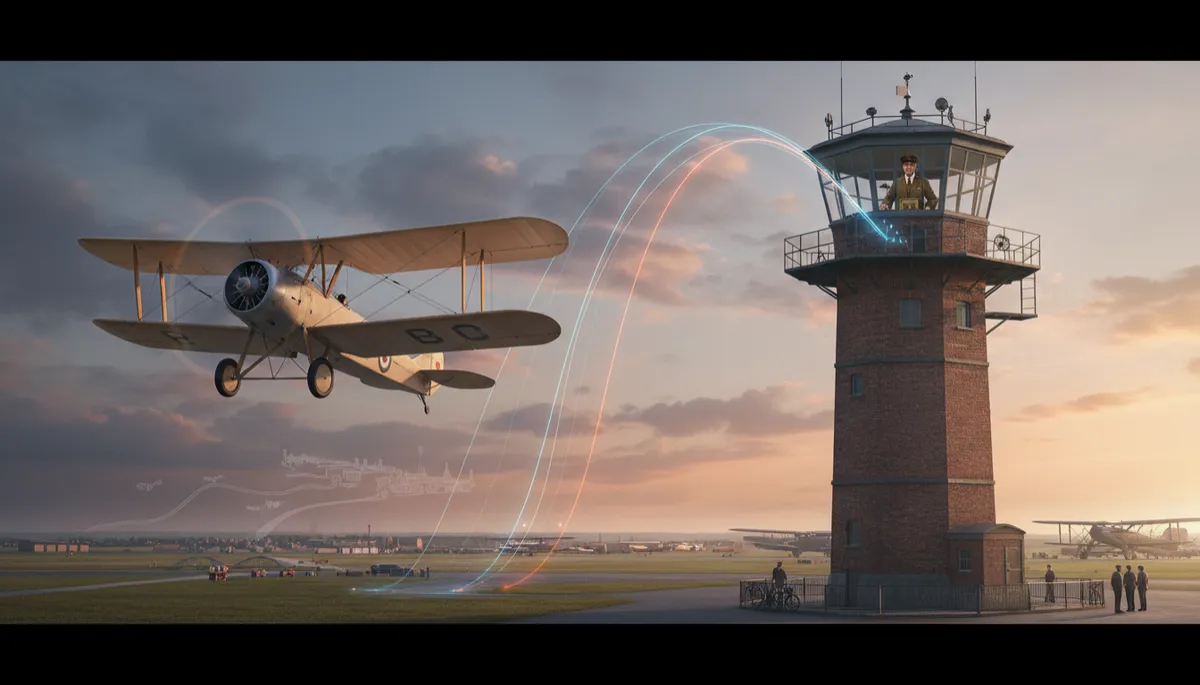
The opening of Croydon Airport as the world’s first air traffic control tower did more than add a building to the edge of London. It rewrote the operating assumptions of flight. Before Croydon, pilots navigated almost entirely by eye and by ground landmarks; after Croydon, a trained controller on the ground became an integral part of every safe journey. For today’s professionals responsible for mission-critical operations, Croydon is a case study in how structured oversight, standardized procedures, and certified expertise can transform risk into a managed system.
Before Croydon: Flying by Landmarks and Judgment Alone
In the years immediately after World War I, powered flight was still closer to an expedition than to a scheduled service. Aircraft were slow, fragile, and lightly equipped. Pilots relied on visual landmarks—railway lines, rivers, church spires, and town centers—to maintain course. Navigation charts were basic, weather information was sparse, and there was no integrated system to coordinate traffic in the air or on the ground.
The basic rule of flight was simple and unforgiving: the pilot alone was responsible for seeing and avoiding other aircraft, terrain, and weather. There were no standardized routes, no assigned altitudes, and no central authority sequencing arrivals and departures. Each pilot operated as an independent decision-maker, with limited information and no real-time support. In practice, this meant:
Navigation by ground features and compass headings, often adjusted on the fly.
Weather decisions based on what the pilot could see ahead and local reports at departure.
Traffic avoidance dependent entirely on “see and avoid” in an environment with growing aircraft numbers.
As commercial routes expanded and London emerged as a hub, this ad‑hoc model was no longer sufficient. The risk profile shifted from individual adventure to public transport. Governments, operators, and insurers began to recognize that relying on landmarks and pilot judgment alone was incompatible with regular, reliable, and safe scheduled operations.
Croydon Opens: The World’s First Air Traffic Control Tower
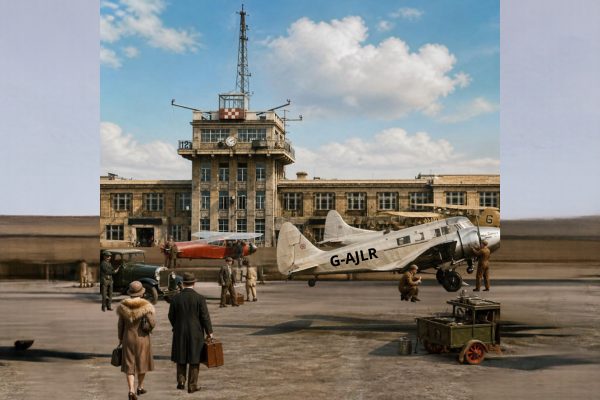
When Croydon Airport opened in 1920 on the outskirts of South London, it was conceived as more than a landing field. It became London’s main airport during the interwar years and, according to Croydon Airport’s own historical records, the site of the world’s first purpose-built air traffic control tower. From 1920 onward, and with formalized procedures in place by 1922, Croydon introduced a new concept: a dedicated, trained controller on the ground with authority to manage aircraft movements in and out of the airfield (Croydon Airport Society; NATS).
Initially, Croydon’s system was primitive by modern standards. Controllers used flags, lamps, and boards to signal to pilots. Yet the operational logic was revolutionary. For the first time, there was a single point of coordination for arrivals, departures, and ground movements. The controller’s task was to prevent conflicting clearances and to maintain an orderly flow of traffic, both on the runway and in the surrounding airspace.
By the late 1920s, Croydon had added radio communication between tower and cockpit. This allowed controllers to issue instructions, share weather information, and coordinate diversions in real time—capabilities that dramatically enhanced safety and predictability (Skybrary). The airport also helped develop standardized procedures and signalling codes that formed the basis of international aviation practice.
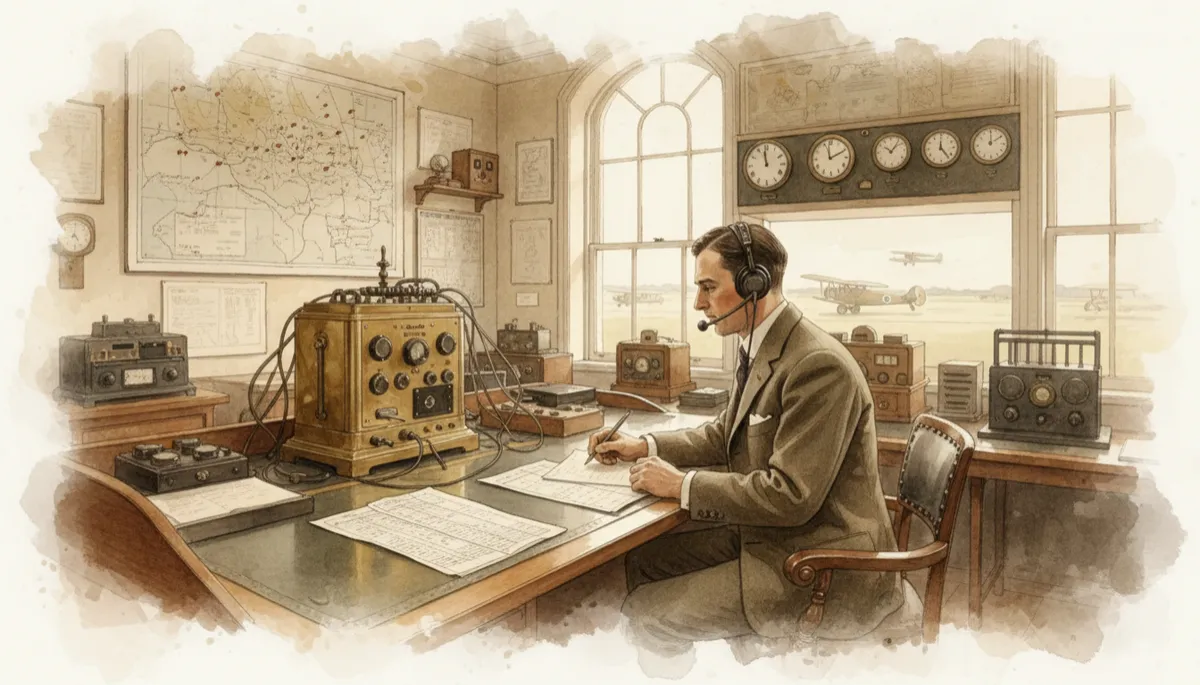
Early controllers at Croydon turned scattered flights into a coordinated traffic system.
What Changed When Croydon Opened: From Individual Flights to a Managed System
The operational shift introduced at Croydon can be summarized in one sentence: someone on the ground was now formally responsible for watching the sky. This change had several concrete effects that professionals in any high‑risk domain will recognize as foundational to modern risk management and command-and-control systems.
1. Centralized Situational Awareness
Before Croydon, each pilot saw only their own aircraft’s position and whatever traffic happened to be visible. After Croydon, the controller maintained a consolidated picture of who was arriving, who was departing, and who was taxiing. Even with simple tools, this central vantage point allowed conflicts to be detected earlier and resolved more systematically than any individual pilot could manage alone.
2. Standardized Procedures and Clearances
Croydon pioneered standard phrases, signalling methods, and movement procedures that other airports later adopted. Over time, this evolved into the structured clearance system we recognize today: no takeoff or landing without explicit authorization from the tower. This removed ambiguity, reduced the reliance on informal judgment, and created a repeatable framework for safe operations—even as traffic volumes grew.
3. Integration of Technology into Human Decision-Making
The introduction of radio at Croydon in the late 1920s marked an early integration of communication technology into operational control. Controllers could now share real-time weather, runway conditions, and traffic advisories. This was the beginning of a continuous trend: pairing human judgment with technology to extend reach, speed, and reliability. Today’s radar, satellite surveillance, and automation platforms are direct descendants of that first step.
A Trained Controller on the Ground: Changing the Basic Rule of Flight
Perhaps the most profound change Croydon introduced was conceptual rather than technical. The basic rule of flight shifted from “the pilot alone is responsible” to a shared responsibility model in which a trained, certified controller on the ground became an essential part of every operation. This was not a loss of pilot autonomy; it was a recognition that complex, high‑density operations require coordinated oversight.
In modern terms, Croydon effectively created a new role in the operational chain: an independent, standardized, and accountable control function. Controllers were trained to established procedures, used common phraseology, and worked from an institutional mandate to maintain safety and order. Their authority to clear, delay, or reroute traffic formalized a layer of governance that had not existed before.
📌 Key Takeaway: Croydon demonstrated that putting certified experts in a central control role can transform a risky, decentralized activity into a managed, scalable system—without removing frontline decision-making authority.
From Croydon to Today’s Towers: A Continuous Line of Control
The principles tested at Croydon now underpin global air traffic management. Modern systems, such as the FAA’s NextGen and the Brand New Air Traffic Control System (BNATCS) modernization effort in the United States, are deploying advanced surveillance, digital communications, and automation. Yet the core idea remains the same as it was at Croydon: trained professionals on the ground maintain a shared picture of the sky and coordinate safe, efficient movement (FAA; GAO).
Today’s controllers work with radar, satellite-based ADS‑B, IP voice systems, and increasingly sophisticated decision-support tools. Remote towers, digital flight strips, and AI‑assisted planning are being deployed to enhance capacity and resilience. But every one of these tools builds on the Croydon insight that complex operations demand a certified, mission-ready control function that is trained, standardized, and accountable.
Lessons for Modern Mission-Critical Operations
For procurement officers and agencies responsible for high‑stakes operations—whether in aviation, emergency response, critical infrastructure, or defense—the Croydon story offers several enduring lessons:
Certified expertise matters. Croydon’s controllers were not simply observers; they were trained professionals operating to defined standards. Modern teams deployed for command-and-control roles must meet similar certification and training thresholds to be effective and trusted.
Central coordination enables scale. As traffic density increased, individual pilots could no longer manage risk in isolation. Likewise, as modern operations scale, centralized, mission-ready control elements become essential to maintain safety and performance.
Technology amplifies, but does not replace, human control. Croydon’s adoption of radio, like today’s adoption of digital and AI tools, extended human capability. The most resilient systems pair advanced technology with trained, accountable operators.
For organizations such as mission-focused deployment providers, the Croydon model reinforces a simple operational truth: having the right team in the right control position at the right time is not optional—it is the system. Just as Croydon’s tower became the organizing center for early commercial aviation, modern agencies rely on certified, rapidly deployable teams to stand up control functions whenever and wherever they are needed.
Conclusion: Someone Is Still Watching the Sky
When Croydon opened, the change was subtle but decisive. Pilots still flew the aircraft. They still watched for weather and traffic. But above and around their individual decisions, a new rule applied: no aircraft moved without coordination from a trained controller on the ground. That rule, born at a single airfield outside London, reshaped global aviation and remains the backbone of modern air traffic management.
Before Croydon, pilots relied on landmarks alone and bore the full weight of navigation and separation. After Croydon, a certified controller, armed with procedures and emerging technology, began to share that responsibility. The result was a safer, more predictable, and ultimately more scalable system. For today’s professionals managing complex operations, the message is clear: structured oversight, standardized communication, and certified, mission-ready teams are not historical curiosities. They are proven, operational necessities—first tested when someone at Croydon climbed a tower, looked out over the airfield, and began watching the sky.